
A Composted Journey
A Composted Journey
Beth Hendry-Yim, Organic Master Gardener
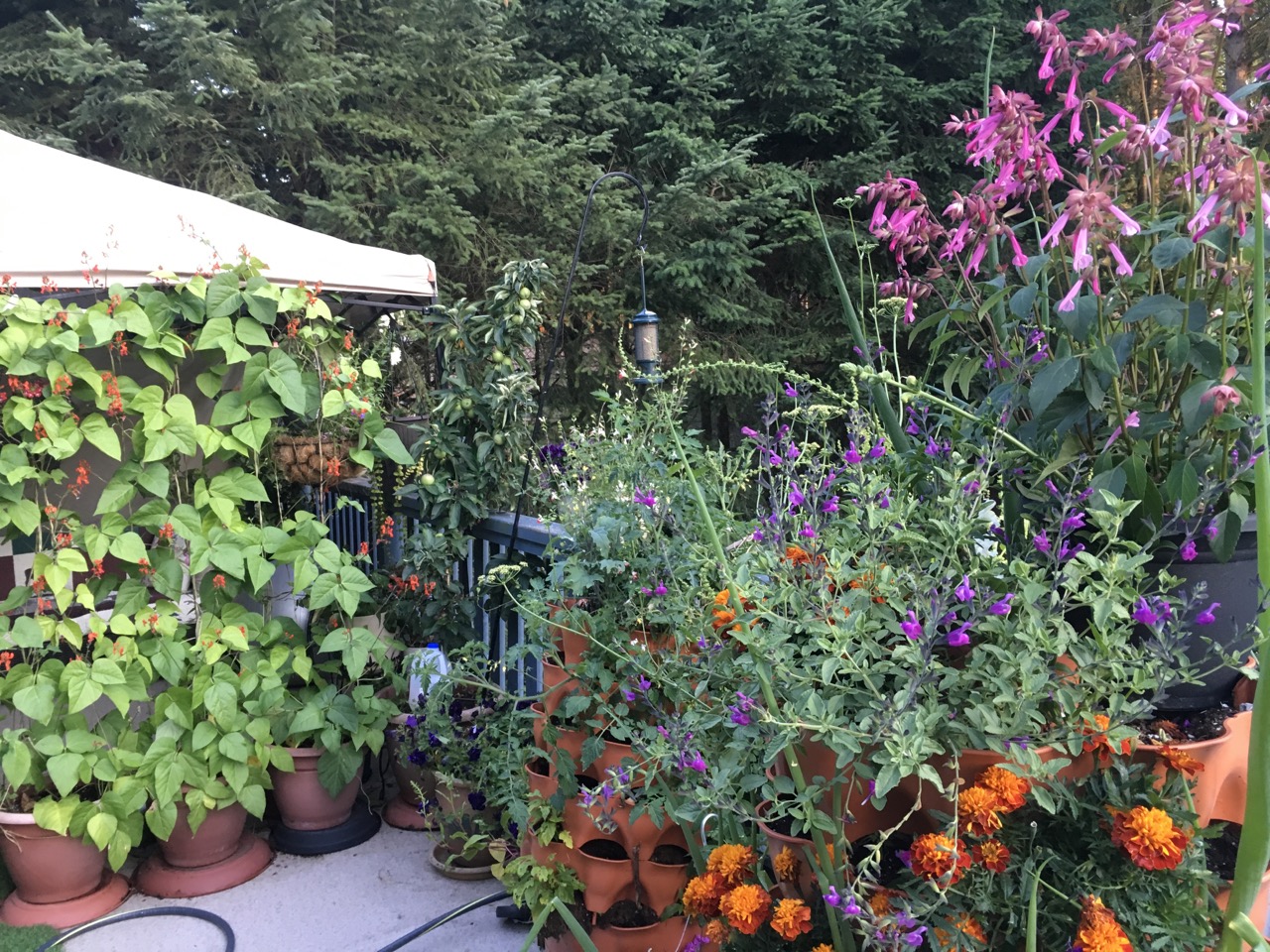 A light drizzle is falling, the weather app on my phone says it will stop mid-morning, that the sun may shine this afternoon. It’s a good day for moving the chicken manure from the run to the compost pile. It’s not my favourite chore. Layers of straw, poop and heavy rain have turned the coop into a mucky ice rink and the hens scratching around the gate and feeding stations looking for insects have created sinkholes that make footing dangerous. I need to use the shovel as a brace, holding on to it tightly and placing my feet carefully all while keeping the hens from escaping out the open door.
We’ve had chickens on and off for almost 40 years with a hiatus while both of us, in separate years, attended school. We kept them illegally in a coop hidden under our cedar trees until 2010 when pressure from other backyard growers pushed the city into creating a bylaw that allowed homes to keep a maximum of six. We’ve raised some from chicks, gotten a few hatched in a friend’s incubator, purchased pullets from a local feed store or farm, and inherited one or two from a social media friend. We’ve had them wander off and return months later, go walk-about in our neighbourhood, die from unknown causes, and get taken by ravens. All have produced eggs to support our needs, provided entertainment for the grandkids and friends, and naturally turned the garden beds while leaving behind their greatest gift in small piles around the garden.
About once every two months the coop gets cleaned out and the old bedding sprinkled about the run. Diatomaceous earth is sprinkled across the cleared flooring followed by a bag of wood chips and straw. It gets layered quite thickly in the fall, winter and spring to provide warmth, absorb moisture and odour, and provide interest for the girls to scratch about when the snow keeps them inside. In the run, old bedding material, over time, breaks down into healthy compost alive with a host of decomposers. We add it to the compost pile by the garden. Leaves will be added when they fall from the apple, plum and cherry trees. When it’s ready it will be added to our raised beds as mulch.
Building compost is a delicate balance between a pile that gets too hot and kills beneficial microbes and not warm enough, taking years to turn into usable soil. But a resilient and sustainable garden is nothing without compost.
In our first home, when I was a young child, Dad would take me with him to a chicken farm in South Surrey. When we arrived, I watched from the cab as he shoveled manure into the cargo bed, turning up my nose at the smell, asking him when we’d be leaving. Dad stood by his chicken manure, saying it was better than horse with less weeds.
“It’s good for the greens in the garden,” he’d say.
On hot days, he’d work up a sheen of sweat, stain his Stanfield white t-shirt; if it was cold, he’d wear the same type of shirt, his body steaming in the cold air. He always said he enjoyed shoveling, his arms lifting and dumping in a steady rhythm, rarely, if ever, stopping for a rest. His shirtsleeves pushed up past his biceps. He used to swing Janice and I from his forearms, raising us up from the ground until we were squealing, mum watching from the sidelines, all of us amazed at the strength of those muscles.
After the truck was loaded, we’d head back home while Dad told me stories of Scotland, the farm he worked at, stepping in fresh cow pies to keep his bare feet warm, living in a railway car with his family after his dad suddenly passed away, the farm dog he loved, quitting school in Grade 9, how the manure needed to sit over the winter to cool down to get ‘sweeter’.
“If the manure is too hot it’ll burn the seedlings,” he’d say, his Scottish brogue mesmerizing and just as interesting to listen to as the stories he told. As we drove through the rich farmland, he’d point out pheasants hunting in an open field, the water covering the flats off Highway 10, spent cornfields, a hawk circling freshly cut pasture, bales of hay waiting to be taken into dry barns.
The manure would get dumped in the empty lot beside our house. It would sit there all winter. If there were grass clippings in early spring, they’d get added to the pile as well. Once a month he would turn it, with me squatting and watching amazed at the microcosm of worms and pill bugs, centipedes and grubs suddenly exposed to light madly trying to escape. Steam rose from the pile for a month or so and then disappeared, the smell tamed by a world of life working its anaerobic magic.
Eventually, I stopped wanting to go to the farm with Dad. Eventually he stopped going and began working out of town seeking advancement within the company he worked for. Mum volunteered at the Ladies Hospital Auxiliary to keep occupied while Janice and I were at school. The garden got smaller, other things and people took away our interest and time and the pile of compost shrunk, taken over by blackberry bushes and time. Now, I’d give anything to go for a drive with Dad again, shovel manure with him, get sweaty and dirty, look at the eagles he’d point out as we drove through Ladner and marvel at the tales he’d tell.
Composting has become more refined nowadays over a pile of hot manure from a local farm, more sterile, less connected to its source. Curbside bins carry kitchen waste and garden clippings away and bring it back as soil. At the dump it costs $20 to dispose of a trailer full of branches and $14.99 to buy it back nicely bagged and ready to add to your garden. And instead of giving it away to backyard garden enthusiasts, farmers add diversity to their income by selling the animal waste as soil - black gold, for $30 a bag, $50 for a trailer full. Or they keep it for themselves in a bid against subsidized chemical fertilizers. A local stable has massive mounds of composting horse manure mixed with straw and bedding. They do a great business and by the end of the summer the pile is almost gone. Turning and bagging it has become a full-time job for the owners on an extra sideline for a business whose costs continue to rise.
Our composting isn’t refined or well thought-out or even reliably successful. We’ve tried most methods. I struggle with impatience. I want my piles of too-big branches and sticks to melt into usable soil now. But impatience is a waste of energy in the garden, especially when composting unless I, like the local stable, want a full-time job and a sore back from constantly turning it to keep it at the right temperature.
The first method we tried was city sanctioned. Free bins advertised as the way to keep your kitchen waste from the city landfill and make your own healthy compost. Square with a lid on the top for easy dumping of scraps and a sliding door at the bottom to collect your composted soil, the bin looked appealing with its promise of efficiency and effectiveness. For more than 20 years, two have sat in or near the garden. We added food scraps, weeds, even shredded paper from the office. Eventually, we did get some return from these bins. Potatoes. By the end of the first few growing seasons, I harvested about 20 large potatoes, the tubers buried with avocado skins, eggshells and partially composted paper but very little soil.
A round bin from Lee Valley that spins to mix the waste was my next purchase. The secret is turning, the advertisement explained. A round container sits on a stand that allows you to spin it, effectively turning the scraps inside. It sits unused behind the front shed. I was excited by the promise of it and eager to get started filling it with food waste. I waited impatiently and waited and waited. It produced nothing but a bad smell and slurry I was loath to touch let alone use on my veggie beds. It was a closed system that held only food waste and some grass clippings so had no connection with soil microbes. The instructions clearly said only food scraps needed. It got a fail too.
The most exciting and promising method I purchased twelve years ago, a garden tower with a central tube for food waste. Touted as turning ‘kitchen scraps into organic fertilizer’ and minimizing the need for watering, it can be planted with up to 50 plants. Scraps go in the central tube, soil in the surrounding tower, plants in holes around the sides. Openings in the tube allow microbes to move back and forth creating a healthy soil ecosystem. These aid in breaking down food waste and feeding the plants. During the breakdown water is produced providing the plants with moisture. A water collection tray in the bottom recovers rich worm tea.
In its first year we harvested lettuce, Chinese greens, kale, chard, onions, beets, and peppers. The following year I harvested throughout the summer only this time I added flowers to add to its aesthetic appeal. The next spring however, after planting transplants I raised from seeds, I started seeing clumps of soil around the base, seedlings buried in an avalanche of soil. Halfway up the tower, a suspicious non-man made hole in the dirt confirmed my worst fear. Rats. I detached the top three trays and the compost tube and saw where they had dug into the dirt and chewed through the plastic to access the kitchen scraps.
In an effort to deter these rapacious rodents I wrapped chicken wire around the entire structure. Unfortunately, it made accessing the vegetables difficult. I even took one completely apart and wrapped the inner tube with chicken wire but it wouldn’t fit back together. The next year, I sold one to a friend out in the country who has less aggressive rats. She has it at the bottom of stairs leading off the kitchen for easy access to the massive tomato plants it produces. The other two are still here, one on the ground and empty, the other on the deck and full of marigolds, salvia, nasturtiums and other perennials. The rats don’t like flowers.
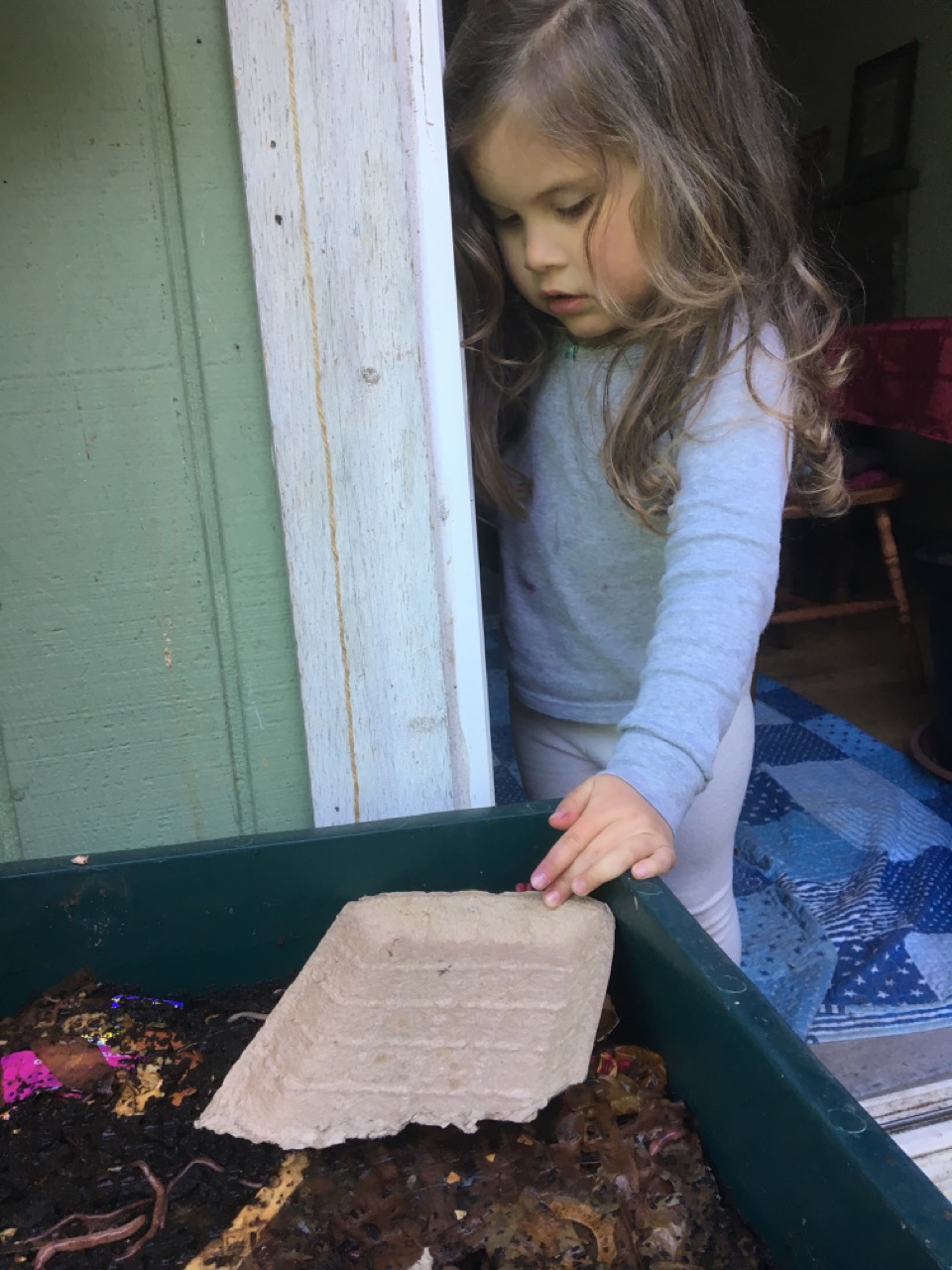 One of the most successful composting systems I introduced has been a worm tower purchased on Amazon for $99.95. It stands five levels deep, at my back door, just off the kitchen. Fully extended, it is about four feet tall. The bottom of the trays have gridded holes with the bottom stand having cheesecloth covering it to collect water and prevent worms from dropping into the water collection tray. Food waste is added, trays are rotated, and the worms turn our veg and fruit scraps into nutrient dense soil for the pots of vegetables growing on my deck. My granddaughter Maze is fascinated by the life it holds and the process that ‘disappears’ food. She often comes up and demands to see the red wrigglers, pill bugs, various centipedes and insects feasting on what we throw out. She loves the moist soil the worms create, listens as I point out new bugs we haven’t seen before, watches as I switch trays, putting the well digested tray on top, the new vegetable leavings on the bottom. In successive visits the worms will have migrated to a fresh batch of food below. Every three months or so I scrape the soil out, mix it into the veg trugs lining the walls of the house underneath my kitchen and bathroom windows or out in the garden in one of the raised beds. It’s rich soil, but not enough to mulch every bed and container. I need more.
Bokashi is a composting method that uses effective microorganisms (EM) or compost activators to ferment organic waste. Invented by a Japanese biologist and agronomist Teuro Higa in the 1980’s Bokashi method breaks down material anaerobically without oxygen or aeration needed. A ‘clean’ method that produces no measurable gases or harmful odours, the EM and anaerobic conditions consume methane producing microbes and any toxic pollutants. (Sask Waste Reduction Council). I purchased a ‘kit’ made up of a five-gallon bucket and a bag of inoculated bran.
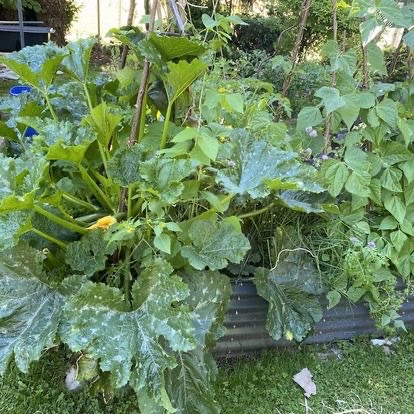
The first batch took only three weeks to produce a ‘pickled’ product, ready to be dug into a raised bed. My second batch, with its tell-tale white fuzzy mycelium threads, went into the same bed. First, I dug a trench about a foot and a half deep, and then I added the fermented waste. I covered both batches with the backfill and let it sit for two weeks before planting with squash, beans, chard, peas, a dead chive plant (at least I thought it was dead) and cilantro. It is the most amazing bed in my garden. The squash leaves are massive, fruit abundant and vibrantly alive with no sign of powdery mildew. The chives, which I removed from a too small container, came back from death’s door more than doubling in size and the beans, Blue Lake Pole, are covered in blossoms. Everything in this bed shines with good health. Who would have thought pickling food scraps would eventually feed my garden? I sure wish Dad was here, I know he’d grumble about new-fangled devices, potential smell in the kitchen (none so far!) and rodents digging in the garden. But so far so good. The pickling process is a real deterrent to either of my dogs digging and the rodents, racoons included, have not gone near it. My goal is to continue producing bokashi and adding it to each of my raised beds, by next year the whole garden should be done.
Dad might have had his chicken manure, but I’ve got my bokashi! Fingers crossed that I’ve finally found the system!
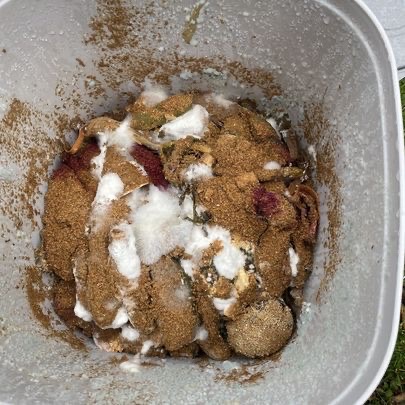
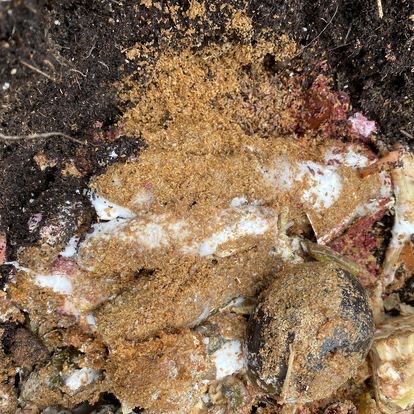
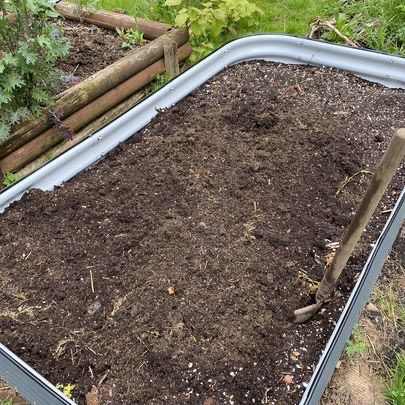
Bokashi in a bucket, with mycelium growing and used in a planting bed.
About the Author
 Beth Hendry-Yim is an award winning writer, author, Nana and self professed lazy gardener. She has written on climate change for several publications including Island Parent and Natural Life, and has reported on less pressing issues for The Navigator and the Nanaimo News Bulletin. She wrote and self published, Fresh Start: A Workbook and Guide to Healthy Living and is currently working on a book about gardening, grandchildren and climate change, in that order. Her love of gardening is driven by a passion to connect with Nature and create a sanctuary for her children and grandchildren for the coming years of + 2 degrees. She lives in Nanaimo with her son, his wife, their two young girls, husband of 40 years, her heart dog, Willie, and his sidekick Sadie, and the billions of tiny creatures living in and around her garden that make food production possible.
